Building Muscle Without Hours in the Gym: The Executive's Guide to Efficient Fat Loss
Two or three resistance sessions a week, a real protein target and protected sleep build the muscle that makes fat burning more efficient around the clock. Here is the minimum effective plan for people with no slack in the calendar.
You do not need to live in the gym to build muscle, and for a busy executive that is the whole point. Two or three well-designed resistance sessions a week, a protein target you actually hit, and sleep that is protected rather than negotiated will add lean mass in most adults over 35. That muscle then does something no diet can: it raises the amount of energy your body burns at rest and makes every calorie you eat more likely to be used than stored. Building muscle is the most efficient fat-loss decision available to someone with very little time.
Why Muscle Is the Executive's Fat-Loss Advantage
Most weight-loss advice is written for people with time. Long cardio sessions, daily workouts, elaborate meal prep. If your calendar is booked from seven to seven, that advice fails on contact, and the usual conclusion is that you lack discipline. You do not. You lack a plan that respects the constraint.
Muscle changes the equation because it works when you are not. Lean tissue is metabolically active around the clock, so a body with more of it burns more energy at rest, in meetings, on flights and in sleep. Cardio burns calories while you do it; muscle changes what your body does with calories for the rest of the day. For someone who can find three hours a week and not one more, that is the difference between a program that holds and one that quietly fails by month four.
How Building Muscle Drives More Efficient Fat Burning
Three mechanisms do the work, and none of them require living in a gym.
A Higher Resting Metabolic Rate
Resting metabolic rate is the energy your body spends simply staying alive, and it accounts for the majority of what most adults burn in a day. Lean mass is the single largest modifiable driver of that figure. Add muscle and the baseline rises; lose it, which is what happens during most rapid weight loss, and the baseline falls. This is one reason people who diet hard and skip resistance training end up maintaining on fewer calories than they started with.
Better Insulin Sensitivity and Nutrient Partitioning
Skeletal muscle is the body's largest site for disposing of blood glucose. More muscle, and muscle that is regularly contracted under load, means carbohydrate is more likely to be stored as fuel in the muscle than converted and stored as fat. Executives who describe an afternoon energy crash after lunch are usually describing poor glucose handling, and resistance training is one of the most effective non-medical ways to improve it.
The Afterburn and Recovery Cost
A hard resistance session raises energy expenditure for hours afterwards as the body repairs and remodels tissue. The effect per session is modest, but it is a cost paid on top of the higher baseline, and it accrues across every week you train. Protein synthesis itself is energetically expensive. Building muscle is, quite literally, a process your body pays for.
The Minimum Effective Dose: Three Hours a Week
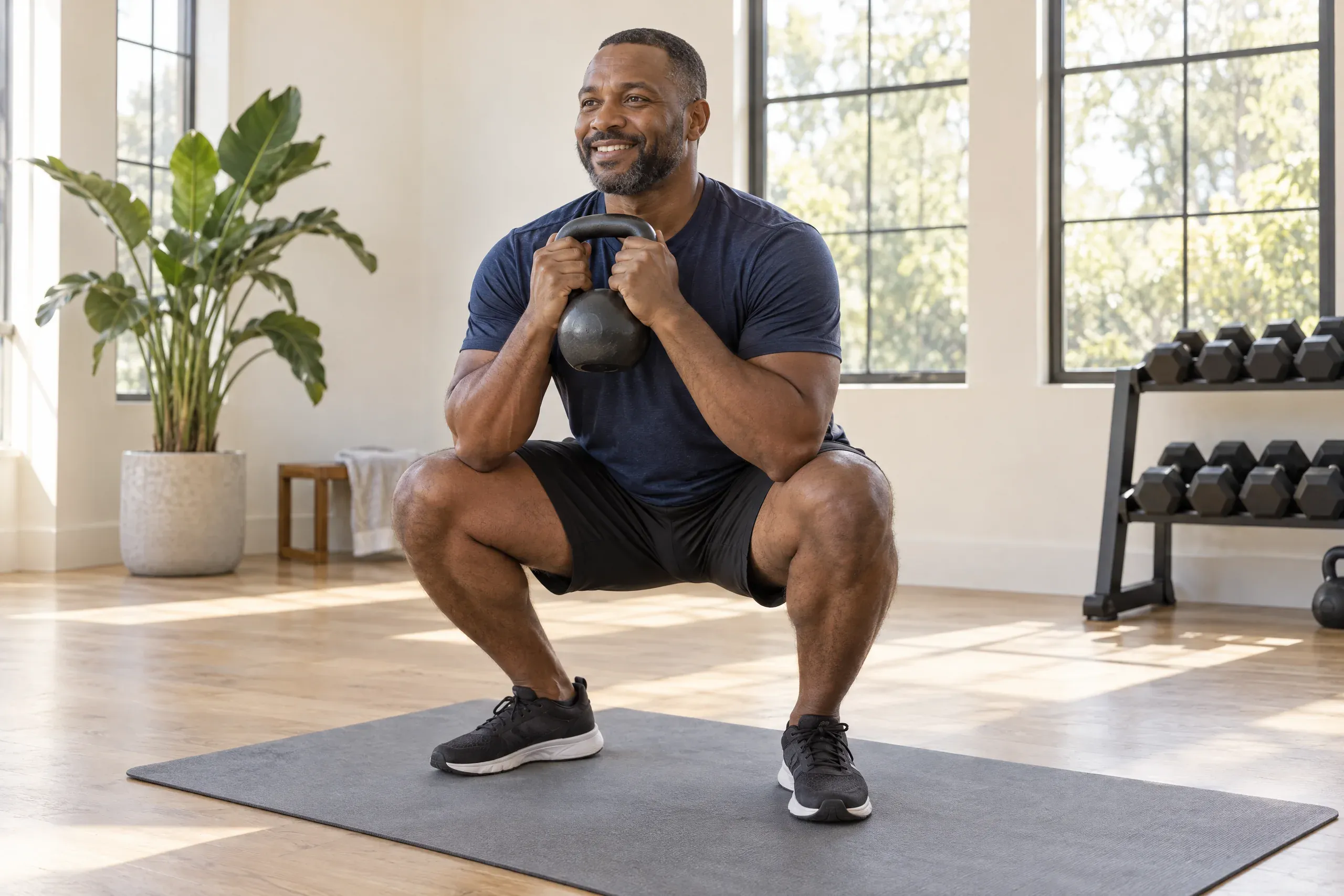
Research on resistance training volume is consistent on one point: the biggest gains come from the first few sessions each week, and returns diminish after that. For most adults, two to three full-body sessions of 40 to 50 minutes, built around a handful of compound movements, capture the large majority of the available benefit. Here is what that looks like in practice.
- Two or three sessions, never zero. A squat or leg press pattern, a hip hinge, a horizontal and a vertical push, a horizontal and a vertical pull. Six movements, two or three hard sets each, and you are done.
- Train close to genuine effort. The last two or three repetitions of a set should feel hard. Sets that stop well short of that do not signal the muscle to grow, no matter how many of them you do.
- Add load or repetitions over time. Progressive overload is the only non-negotiable. Write down what you lifted and beat it, slowly, over weeks.
- Protein at every meal. Aim for roughly 0.7 to 1 gram per pound of goal body weight per day, split across three or four meals. Most stalled clients we see are eating half that.
- Protect sleep like a board meeting. Muscle is built during recovery, and the hormones that drive it depend on sleep. Seven hours is the floor, not the target.
- Walk more. Daily movement is the cheapest metabolic lever available, and it costs no gym time. Take the calls on foot.
Why the Scale Will Lie to You
If you do this properly, the scale may not move for a month, and it may briefly go up. That is not failure. Muscle is denser than fat, so trading a few pounds of one for a few pounds of the other produces a smaller, firmer body at the same weight. It also produces a lot of abandoned programs, because most people are judging themselves on the one number that cannot see the change.
This is why every program at Aspire Trim Clinic starts with a Styku 3D body composition scan and rescans at intervals. The scan reports body fat percentage, lean mass and circumferences at every anatomical landmark in about 35 seconds, with no radiation. When lean mass is climbing and body fat is falling on an unchanged scale weight, you are winning, and you get to see it. When lean mass is falling, we change protein and training before we change anything else.
Where Coaching Fits, and Where It Does Not
Knowing the plan is rarely the problem for people who run organizations. Executing it in a life with no slack is. Coaching at Aspire Trim Clinic means a written program built around your real schedule, a protein target set by a registered dietitian, resistance programming from our exercise science specialist, scheduled check-ins in person or by video, and body composition scans so progress is judged on fat and muscle rather than mood. Read how our program works for the full sequence.
Aspire Trim Clinic is not a medical practice and does not diagnose, treat or prescribe. Where labs or a medical review are appropriate, for example when strength stalls despite consistent training and a hormone question needs answering, we arrange a telehealth visit with Impact Health Network licensed physicians, who make any clinical decision. We coach, we measure, and we are your point of entry.
Frequently Asked Questions About Building Muscle With Limited Time
How many days a week do I need to lift to build muscle?
Two to three full-body sessions a week is enough for most adults to gain lean mass, provided each session includes a few compound movements taken close to genuine effort and the load increases over time. More sessions add a little; consistency adds a lot.
Does building muscle really help you burn fat?
Yes, through a higher resting metabolic rate, better glucose handling and the recovery cost of training. The effect is gradual and cumulative rather than dramatic per session, which is exactly why it suits people who need a program that works in the background.
How long does it take to see results?
Strength improves within two to four weeks, mostly from better coordination. Visible and measurable lean mass change typically shows on a body composition scan by eight to twelve weeks, and continues for as long as training and protein are consistent.
Can I build muscle after 40 or 50?
Yes. Adults in their fifties, sixties and beyond gain muscle with resistance training in study after study. The rate is slower than at 25 and recovery needs more respect, but the metabolic payoff is, if anything, more valuable because age-related muscle loss is what you are reversing.
Should I do cardio as well?
Some, for heart health and recovery, but if you have three hours a week and one goal, spend most of it under load. Daily walking covers much of what low-intensity cardio would, and it costs no scheduled time.
Book Your Body Composition Scan in Charlotte, NC
Come in for body composition and program development to build 25% more muscle without hours in the gym every day. Book a free consultation at Aspire Trim Clinic in Matthews, minutes from Charlotte. You will get a Styku 3D body composition scan, an honest read on where your lean mass sits today, and a coaching plan that fits the calendar you actually have. Call (704) 321-0105 or request your free consultation. Learn more about our 3D body composition scan and weight loss coaching in Charlotte, NC.